
week 6 of sustainable systems class started of by giving a gist about our survey and what we had derived from it .
post which we had to discuss and explain the class about how does sustainable consumption and production now affect mumbai city as an whole , how does it positively or negatively contribute to our topic , we had to support the same through a case study, and after that we had to identify the problem statement supporting our topic and affecting Mumbai city as an whole.
Survey gist:
- There is awareness about using LED instead of the CFL bulbs in the household sector upto a great extent, wherein the commercial sector there is still around 50 % of people using CFL and Fluorescent tubes.
- 33% of the people notice wastage of water in some or the other way at their workplace.
- 70 % of people bathe using showers, and for about 20- 25 mins minimum on a daily basis, whereas there are a few aware and mindful people who use a bucket to bathe, and save on water wastage.
- 65% of people in the household sector travel through their personal vehicles, on a general basis, which is contributing to the increase of carbon footprint, and spend a good amount on petrol on a monthly basis. Whereas in the commercial sector 58.3% of people travel for work using other modes like public transport , car pool etc and 41.% of people travel to work through their private vehicles.
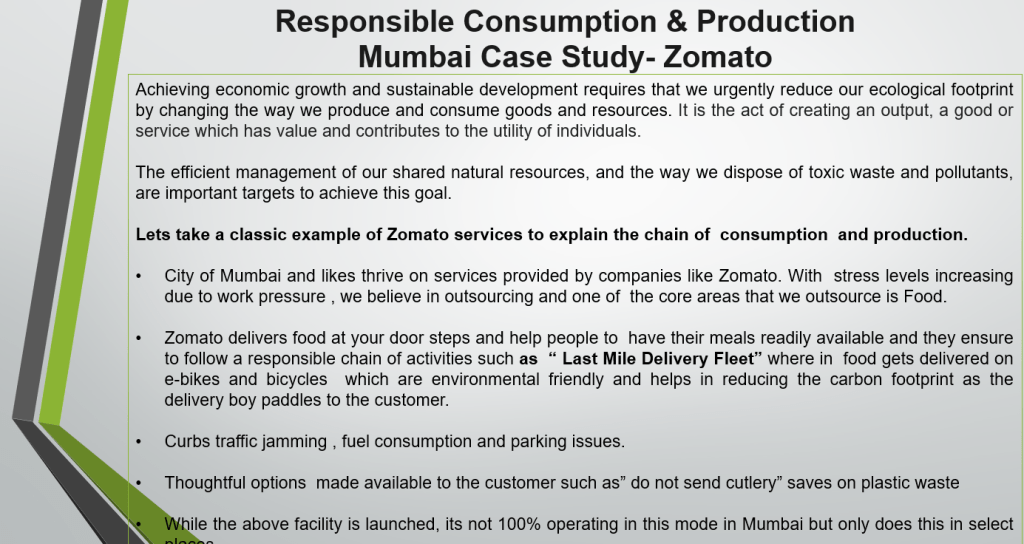
We then described our research through a case study of Zomato food delivery company, we explained how it affects various factors of consumption and production:
- Consumption and production is like a chain of demand and supply for the same, and Zomato food delivery was a best example to explain the same,
- Firstly energy consumption in the form of fuel, the debate is unproven whether Zomato food delivery reduces carbon footprint and consumption of fuel and less reduction of co2 in the atmosphere or it is equivalent to individuals going personally to the restraint and eating food than ordering it from Zomato, but according to me it does help in carbon footprint reduction,
- imagine 5 groups of people in different vehicles travelling to the restraint they want to eat food from , spending fuel , money and emitting co2 per vehicle or a single person delivering food from their favourite restaurant to these 5 groups in their individual places, I feel something is better than nothing hence co2 emission and fuel consumption by one vehicle than 5 vehicles is quite less, and helps in saving a lot in one or the other way.
- Well in their defence Zomato has started an initiative which is witnessed in some parts of Mumbai which is called ‘Last mile delivery fleet where food is delivered by Zomato boys on e- bikes and bicycle an initiate which is environment friendly and helps reduce carbon footprint.
- Curbs traffic jamming, and parking issues
- It has an option available on their site which says ‘ don’t send cutlery’ to reduce plastic consumption
- But on the other hand they have food packaged in plastic containers which non degradable.
We then mentioned the stake holders present in this chain
- The three key stakeholders of Zomato are:
- Consumer
- Restaurants
- Delivery App ,delivery people.
- The consumers get ready food at their door steps.
- The restaurants deliver through Zomato network
- The Delivery app brings in convenience to the consumer and also to the restaurants
We ended by identifying the problem statement of plastic consumption and production in general as well as food sector.
We had to do further research about the same in our next class.

 Sanjana blogs