
Week 4 of sustainable system was about presenting our work in front of the class with a detailed presentation on our topic which gives all the information about our research for the same, including the statistics.
Detailed study:
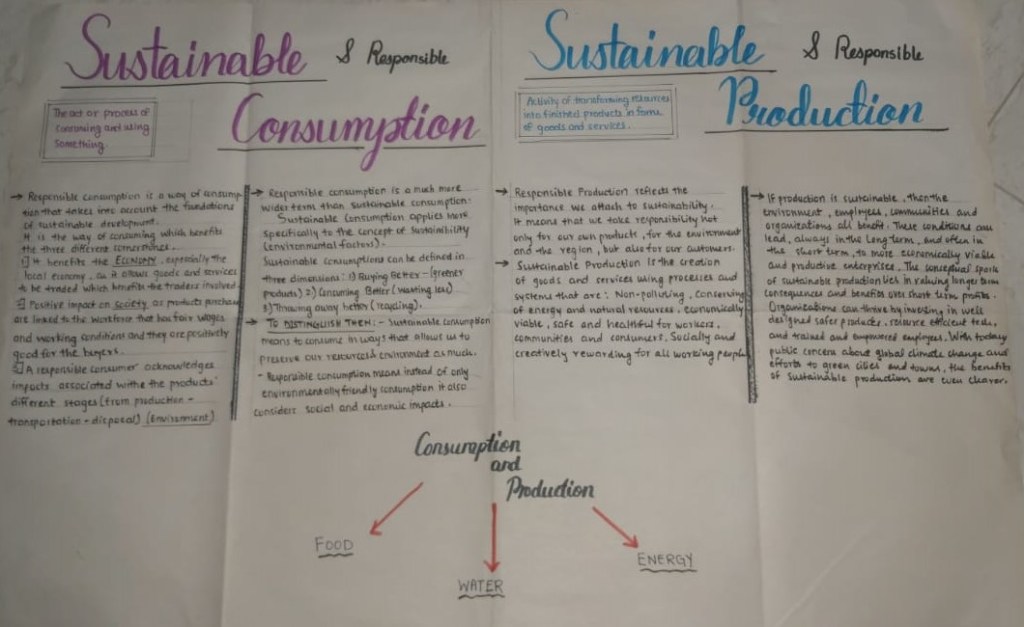
- What responsible consumption and production means as a whole:
- Promoting the effective usage of resources
- Energy
- Keeping the society as an important factor
- Sustainable infrastructure
- Considering about the future economic conditions
- Reducing poverty largely.
We researched as to what consumption and production as an individual mean?
Consumption can be termed as the action of using up a resource, products or resources, Whereas production can be termed as the action of making or manufacturing from components or raw materials, or the process of being so manufactured.
We then tried to understand what responsible consumption and production means:
Responsible production involves the production of goods and services in an ethical way which involves the minimisation of waste and pollution
Sustainable consumption and production is about promoting resource and energy efficiency, sustainable infrastructure, and providing access to basic services, green and decent jobs and a better quality of life for all.
We then measured and studied about the responsible consumption and production in 3 aspects such as
Food, water energy in the form of fuel and electricity
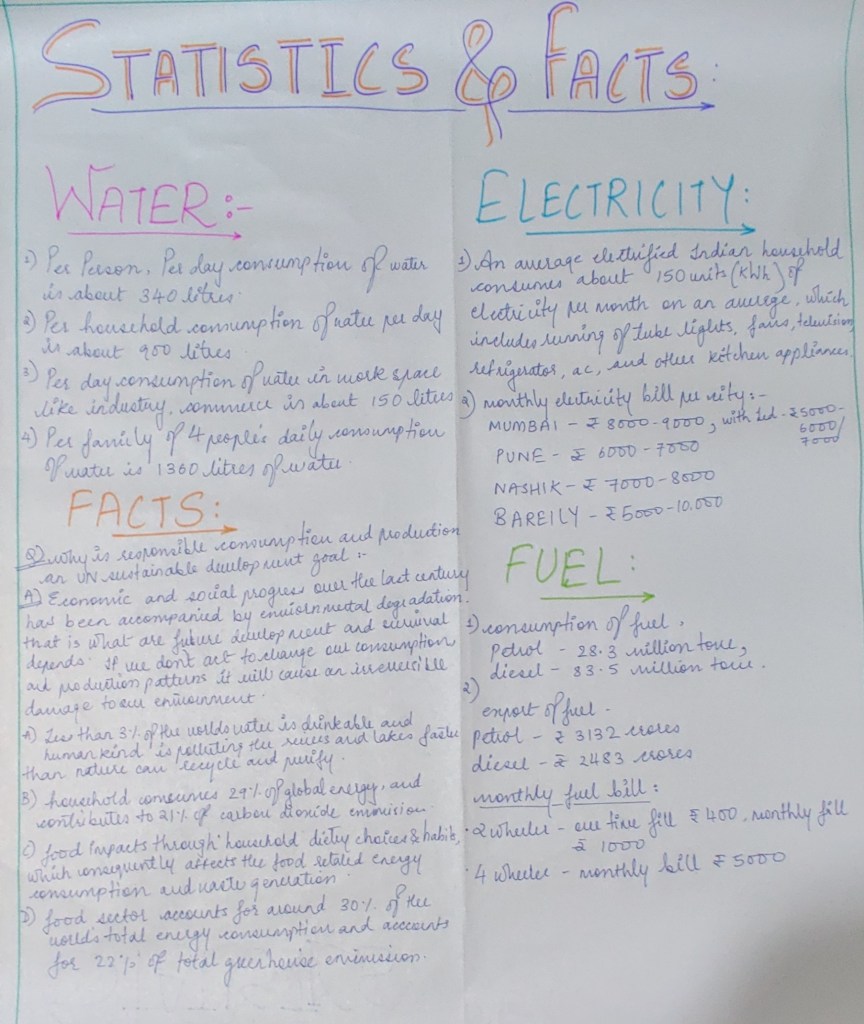
Where we found out statistics for individual:
WATER:
- Per person per day consumption of water is 340 litres
- Per household water consumption per day is about 900 litres
- Per day consumption of water in a work place like industry and commerce is about 150 litres
- Per family of 4 people’s daily consumption of water is 1360 litres per day.
ELECTRICITY;
- An average electrified Indian house hold consumes about 150 units( kwh) of electricity per month on an average which includes the running of lights , fan , ac, television, refrigerator, and other kitchen appliances .
- Monthly electricity bill per area depends and varies any where between 5000 rupees – 10,000 rupees.
FUEL:
- Consumption of fuel , petrol-28.3 million tonne
- And diesel is about 83.5 million tonne.
We found few important facts and figures:
- Less than 3% of the worlds water is drinkable and humankind is polluting the rivers and lakes faster than nature can even recycle and purify it.
- Households consumes29% of global energy, and contributes to 21% of the carbon dioxide emission.
- Food impacts through household dietry choices and habits, which consequently affects the food related energy consumption and waste generation.
- Food sector accounts for around 30% of the worlds total energy consumption and accounts for 22% of the greenhouse gas emission.
We then researched as to why is responsible consumption and production one of the un sustainable development goals.
Basically, the economic and social progress over the last century has been accompanied by the environmental degradation that is what our future development and survivals depends on. As some or the other way its affecting largely on the economic pillar of a sustainable developed system which will lead to the failure as an whole.
We represented the following in 2 charts one the informative, introductory chart and the second facts and statistics chart.
The second half of the lecture was about the introduction to second half of this project which was a survey to be taken.
A survey of 10 questions related to our topic which explain the objective behind understanding about how much people are awared about sustainable consumption and production , about what people are doing to bring in a change , how much are they positively and negatively affecting the enviornment and economic and society through the aspects such as food, water, energy.

 Sanjana blogs